
Authors:
Martina Bocci, CNR Italy
Tea Marasovic, PAP/RAC
Ivan Sekovski, PAP/RAC

.
In light of the challenges posed by climate change, restoring ecosystems that have been degraded, damaged or destroyed allows nature to bounce back and flourish.
Discover three impactful types of restoration measures employed across the marine environments surrounding the MSP4BIO test sites
.
In May 2020, the European Commission adopted the EU Biodiversity Strategy for 2030 which outlines an ambitious plan to protect and restore biodiversity in the EU over the coming decade.
This Strategy, a core part of the European Green Deal, sets out the targets to protect 30% of the EU’s Seas and strictly protect at least a third of the EU’s protected areas.
.
In marine management, different levels of marine protection are provided by area-based management tools – marine protected areas (MPAs) and other effective area-based conservation measures (OECMs). According to EEA (2023), over the last decade, the total area covered by MPAs in the EU has increased substantially – from 5,9% in 2012 to 12,1% in 2021 owing to the expansion of the Natura 2000 network and protected areas established at the national level.
Despite this increase in protection, marine ecosystems continue to face growing pressures from climate change, coastal development, overfishing, pollution, marine traffic, and other human activities, warning us that nature protection needs to be complemented by nature restoration efforts. The UN Decade on Ecosystem Restoration, running from 2021 through 2030, serves as a rallying call for the protection and revival of ecosystems worldwide to achieve global goals. Most recently, the European Parliament voted in favour of the proposed Nature Restoration Law. This Law, which entered into force on 18 August 2024, sets a target for the EU to restore at least 20% of the EU’s land and sea areas by 2030 and all ecosystems in need of restoration by 2050. In terms of marine ecosystems, this entails the restoration of habitats like seagrass beds or sediment bottoms which provide significant benefits, including climate change mitigation, and restoring the habitats of iconic marine species such as dolphins, porpoises, sharks, and seabirds.
Based on the analysis presented in the MSP4BIO project deliverable D 2.3 “State-of-the-art overview of the protection and conservation measures”, we are focusing on three distinct restoration measures and examples of best practice: the establishment of artificial reefs, restoring oyster habitats and the rehabilitation of seagrass meadows.
.
Building artificial reefs
If you enjoy scuba diving, maybe you had the opportunity to come across artificial reefs and discover the rich marine life they host. Built of natural or human-made materials, these intentionally placed benthic structures are designed to safeguard, enhance, or restore various components of marine ecosystems. Besides creating opportunities for underwater recreation and ecotourism, they bolster artisanal, commercial and recreational fisheries, and support aquaculture. Most importantly, they play a key role in conserving coastal habitats, preserving biodiversity, and driving forward scientific research.
Under the transnational LIFE DREAM project, which stands for “Deep REef restoration And Marine litter removal”, four areas across the Mediterranean Sea have been targeted – the Monopoli shelf and the Bari Canyon (Apulia region, Italy), Dohrn Canyon (Campania region, Italy), Seco de los Olivos Seamount (Almeria region, Spain) and the National Marine Park of Alonissos (Thessaly region, Greece) – to combine active and passive restoration measures. In these areas, marine species are at risk of becoming entangled in lost fishing gear, such as nets and longlines, while the entire marine habitat is under significant pressure from littering, especially plastic waste.
.
The Dohrn Canyon, for example, is particularly affected by the illegal dumping of garbage bags and marine litter, so much that it completely drapes its sea bottom in some areas.
In each project site, artificial reef structures (ARS) will be deployed to provide new hard substrates suitable for the settlement of new colonies. In addition, the project aims to employ a remotely operated vehicle to remove marine litter, engage fishers in “fishing for litter” campaigns, and recycle marine litter into marine fuel.

In the picture is Giovanni Chimienti, with photo credits belonging to the LIFE DREAM Project.
.
Restoring oyster habitats
European flat oyster (Ostrea edulis) was once the cornerstone of French oyster farming. In the 1960s, production reached over 20,000 tons per year, but by the 1970s, it had collapsed to just 2,000 tons due to two parasitic diseases, Bonamiosis and Marteiliosis, which still persist today. To help the struggling industry, the Japanese cupped oyster (Crassostrea gigas) was introduced. Unfortunately, the Ostrea edulis population, which plays a vital role in forming biogenic reefs, controlling erosion, purifying water, and improving overall water quality, has never fully recovered. In response, the European Native Oyster Restoration Alliance (NORA) was formed in 2017, bringing together scientists, NGOs, and oyster producers to restore Ostrea edulis populations. As part of MSP4BIO’s overview, several innovative oyster restoration techniques in the North Sea were mapped. One example is the Flat Oyster Recovery (FOREVER) project in Brittany, France, where oyster shell debris is recycled and mixed with cement to create a high-affinity substrate. While these restoration efforts typically focus on coastal waters, this project shows that oyster beds can also be restored offshore.
Another successful restoration is underway in the Firth of Dornoch, Scotland.
Partnering with a whiskey company, this project has already restored 20,000 oysters, with a goal of 200,000 across 40 hectares. Similarly, in Belgium, the UNITED project has worked on oyster restoration within a North Sea wind farm, highlighting the potential for private sector involvement in these efforts.
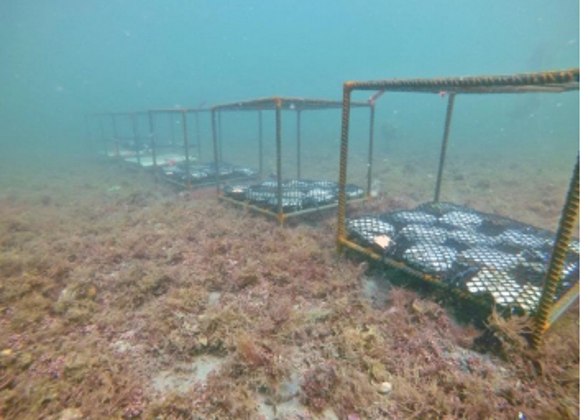
Photo credits: S. Pouvreau / Ifremer (FOREVER project)
.
Seagrass restoration
Did you know that seagrass is our incredible ally in the fight against climate change?
According to WWF-UK, seagrass has the astonishing ability to capture carbon up to 35 times faster than tropical rainforests on a global scale. Despite covering less than 0.1% of the seafloor, seagrass meadows account for 10-18% of total ocean carbon storage. Beyond their carbon-storing superpowers, seagrass can also help protect our coast from damaging storms and erosion through dampening the force of waves and is very effective at removing pollutants from our waters.
These underwater meadows aren’t just invaluable to the environment – they are a vital habitat for marine life, providing an abundance of ecosystem services. Globally, 10,000 m2 of seagrass habitat can support 80,000 fish and over a million invertebrates. However, these crucial habitats are declining due to damage from boat anchors, coastal development and pollution.

.
To combat this decline, an increasing number of initiatives are turning to seagrass transplantation to bring these meadows back to life. Among these efforts was the MERCES project, referred to in full as “Marine Ecosystem Restoration in Changing European Seas”. This project uses innovative solutions to restore degraded marine ecosystems across European waters which are covered by an estimated 6.000 km2 of seagrass meadows – an area more than twice the size of Luxembourg.
Using different restoration methods such as transplantation, translocation and seeding, MERCES has achieved high success rates in restoring seagrass meadows. Learn more about their restoration experiences and lessons learned by exploring the project’s StoryMap.
Moreover, the Arrábida Natural Park in Portugal shows how successful the restoration of Zostera marina (a type of seagrass) can be. Since 2011, the area covered by this seagrass has grown about five times, from 11 m² to a much larger size. However, certain human activities have started to affect this progress, which underscores the need for regular monitoring and stronger protection in Marine Protected Areas (MPAs).
Drawing from experiences in the UK and Ireland, the Seagrass Restoration Handbook offers a comprehensive overview of seagrass restoration projects, highlighting the entire process from initial design and planning to public engagement and communication for restoration projects.
When implementing these initiatives, it is crucial to highlight the vital functions of seagrass, such as providing habitat for marine life, storing carbon, and protecting coastlines. Effective communication can transform public perception from seeing seagrass as merely ‘just grass’ to recognizing it as a “superhero” of the seas. This shift is essential for garnering the support and action needed to protect and restore these indispensable underwater ecosystems, ensuring their benefits for future generations.

Image based on image from Gamble C. et al (eds) (2021). Seagrass Restoration Handbook. Zoological Society of London, UK., London, UK.”
.
Combining protection and restoration for resilient marine ecosystems
In conclusion, as highlighted in our project deliverable, integrating protection and restoration measures is crucial for effective marine ecosystem management. These approaches should be employed together to maximise their synergistic benefits, improving the chances of achieving desired outcomes. While fully restoring ecosystems to their original conditions may not always be feasible due to their dynamic nature and the impacts of climate change, enhancing resilience becomes a critical objective.
Long-term planning and strategic implementation are essential for the success of both protection and restoration measures, as they must adapt to both socio-economic and environmental changes. Moreover, incorporating restoration measures into Marine Spatial Planning (MSP) is vital for advancing biodiversity conservation, preserving environmental quality, and ensuring the sustainable use of marine resources.

