
Authors:
Inne Withouck, Flanders Marine Institute – VLIZ
Isabelle Rombouts, Flanders Marine Institute – VLIZ
Margarita Stancheva, Center for Coastal and Marine Studies – CCMS
Fien De Raedemaecker, Flanders Marine Institute – VLIZ
Natascha Jaspert, s.Pro – sustainable projects
Ivana Stojanovic, s.Pro – sustainable projects
Where do we stand and where are we heading? – Analysing the coherence of maritime polices and management tools, and their effectiveness for conservation targets is crucial for advancing knowledge-based Maritime Spatial Planning (MSP).
The decline of biodiversity in European sea waters presents a major environmental challenge. Various management tools, including Maritime Spatial Planning (MSP), Marine Protected Areas (MPAs), and the Marine Strategy Framework Directive (MSFD), have been introduced to protect marine ecosystems. However, these tools must align with the EU Biodiversity Strategy, which aims to protect 30 % of European waters by 2030, with one-third under strict protection. Despite these efforts, gaps remain in the integration and coherence of these tools, and conservation targets are still unmet.
Site Specific Gap Analysis
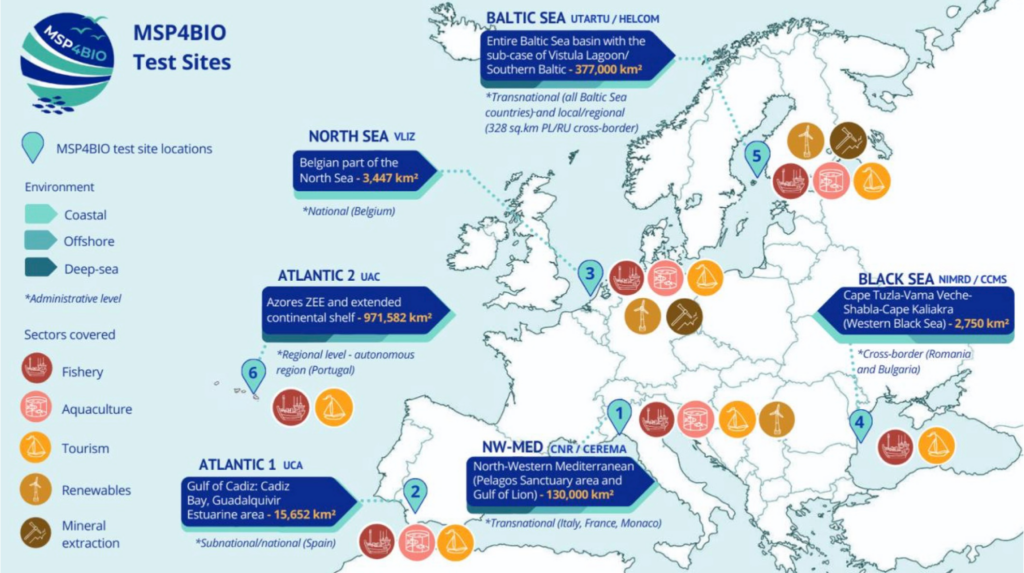
In the six MSP4BIO test sites across five European sea basins, a thorough gap analysis identified several issues, divided into four categories, that hampered the effective integration of marine protection and MSP. This was validated with the Communities of Practice (CoPs) in the test sites made up of MSP and MPA authorities, sectoral representatives, researchers and environmental organisations.
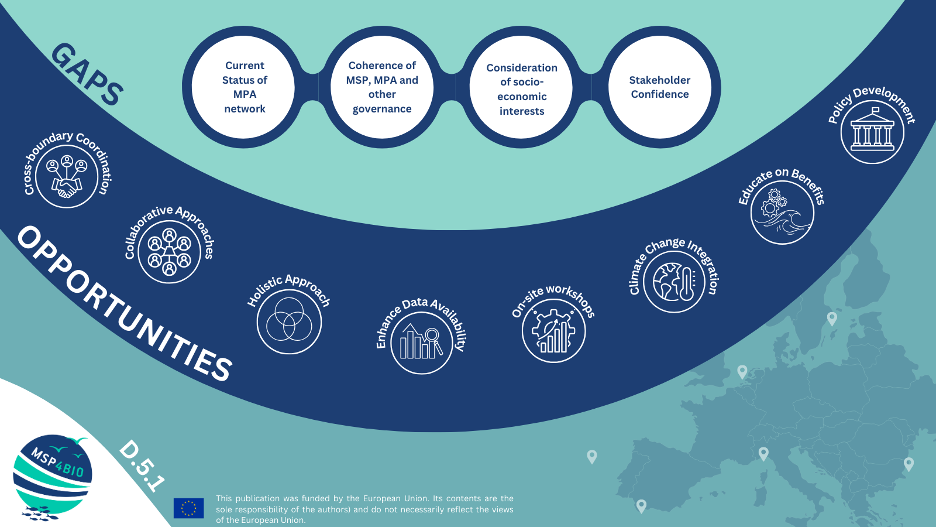
- Current status of MPA network: Many MPAs suffer from inadequate design, such as insufficient coverage of key species, habitats, or vulnerable locations. Climate change and the importance of ecological connectivity are not sufficiently addressed, weakening the long-term resilience of protected areas. Furthermore, there is a growing need to incorporate social and economic criteria in the designation of MPAs to ensure sustainable outcomes for both communities and ecosystems.
- Coherence of MPAs, MSP, and other governance: A lack of financial and human resources was a common issue across test sites, alongside a need for better coordination between management processes, especially between MSP and MPAs.
- Consideration of social and economic activities within MPAs: Decision-making in MPAs often neglects to consider the pressures of competing activities such as shipping, tourism, and fishing. This oversight leads to conflicts that undermine the long-term viability of both ecosystems and local industries.
- Stakeholder confidence: Social acceptance and stakeholder engagement in management endeavors are a vital part of MPAs to succeed and although engagement mechanisms across test sites are in place, overall confidence in ecosystem-based MSP is low. Stakeholders struggle to see the interlinkages of ecosystem services and economic activities and growth, hindering broad support for conservation efforts.

Opportunities
The gap analysis across test sites revealed multiple opportunities for advancing the integration of MPAs and MSP. This has been pushed further in the next phase of MSP4BIO for developing site-specific strategic and spatial solutions. Here are some key opportunities that were identified:
MSP4BIO wants to push for an improvement of data availability and integration of climate change projections in planning processes to enhance the adaptive capacity of marine ecosystems and support evidence-based decision making.
Socioeconomic perspectives are imperative to consider for MSP and MPAs to succeed, therefore on-site workshops and education on ecosystem services could boost stakeholder confidence and help the enforcement of management measures.
Collaborative approaches, such as the established “Communities of Practice”-based approach with key stakeholders as well as cross-boundary coordination could boost the inclusive design and management of MPAs and MSP.
By analysing policy coherence, conducting science-policy dialogues, and providing recommendations, MSP4BIO can actively promote informed policy development in MSP and MPA governance.
Next steps
These findings are being used to inform ongoing processes of MSP4BIO and support the development of a holistic approach to Maritime Spatial Planning and marine protection, integrating ecological, social and economic aspects. MSP4BIO is now focusing on:
- Adaptation of the Ecological-Socio-Economic (ESE) Framework to better fit the test sites
- Implementation of the ESE Framework in all six test sites producing site-specific solutions
- Consolidation of actionable recommendations derived from test site experiences
- Sharing lessons learned from MSP4BIO to enable knowledge transfer worldwide, scaling up and uptake.
If you want to dive deeper into the findings and recommendations, download the report here. Keep up with MSP4BIO as we drive innovative solutions for maritime spatial planning and biodiversity conservation.

